Vardon in America
In 1900 the greatest golfer in the world spent the best part of a year touring the United States. He came home with a national championship, a sheaf of newspaper cuttings and a firm conviction that the young American game was going places.
By GolfProse · · 5 min read
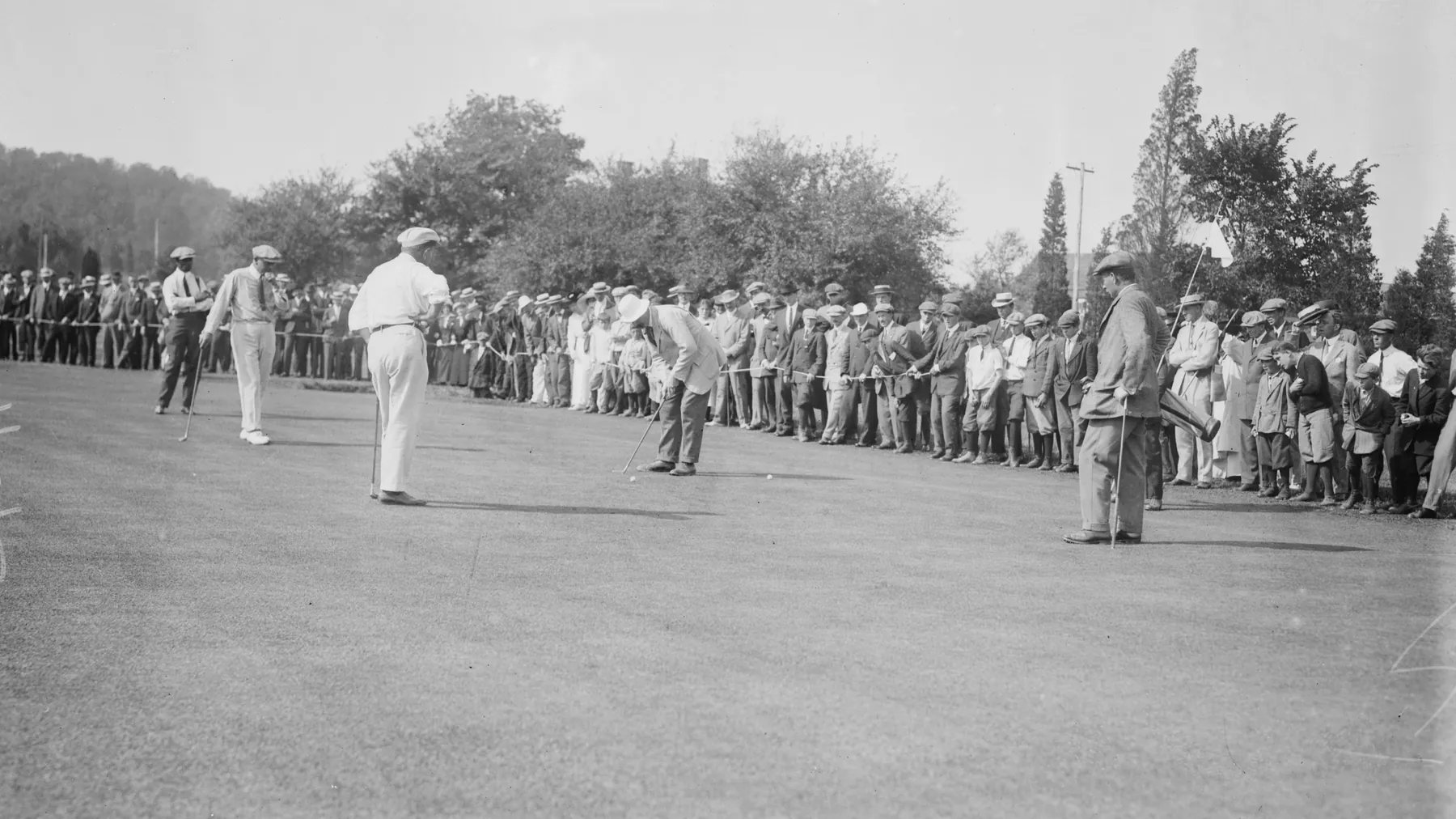
When Harry Vardon sailed for the United States in 1900, most British golfers regarded the American game as a curiosity. Vardon came back with a very different view. In the chapter on golf in America in The Complete Golfer, published five years later, he opens by admitting that he holds “a higher opinion of both the present and the future of golf in America than that which seems to be entertained by a large number of eminent players in this country.”
It is a generous, observant and often very funny chapter, and it reads now like a postcard from the moment the game crossed the Atlantic for good.
A long tour
The tour began in March and did not end until the close of the year, broken only by a flying trip home in the summer to play in the Open Championship, where he finished second to J.H. Taylor. At the time, he says, Englishmen took American golf about as seriously as they might have taken the game “in Timbuctoo if they had heard that it was being played there.”
The record he compiled is remarkable. Vardon travelled thousands of miles and won more than fifty matches, halving two. He suffered thirteen defeats in all, but eleven of them came when he was playing the best ball of two or more opponents, which was the task usually set for him. Only one man beat him on level terms: Bernard Nicholls, first at Ormonde and then at Brae Burn. The course at Ormonde, Vardon notes drily, had not a blade of grass on it.
Some of the margins were enormous. He beat Willie Dunn by sixteen up with fifteen to play at Point Comfort. Vardon is careful to say this was not a sign of weak opposition: he believed he was playing the best golf of his life, helped, he thought, by the dry air and the shirt-sleeved freedom of American golfing dress. He never drove so well, he says, as he did with the old gutty ball that year.
The golf fever
What strikes him most is the enthusiasm. The crowds were huge, with a large proportion of ladies, and everyone seemed to be studying his grip. After one good cleek shot, a spectator vaulted the ropes and demanded of a friend of Vardon’s: “Say, which arm did he do that with?” Vardon checked that his limbs were all in order before discovering that “arm” meant “club.”
Businesses closed for the afternoon when he played nearby, and on one occasion the Stock Exchange did the same. Golf shops did a roaring trade, and Nicholls, having beaten the champion, sensibly declined a rematch for a long time because his victory had been so good for business. Vardon was offered all kinds of lucrative engagements, and accepted one: hitting balls into a net in a Boston store, half an hour at a time, before fresh audiences of about two hundred. To relieve the monotony he began aiming at a spot near the ceiling, until the manager rushed up to warn him that the tap of a fire-extinguishing system was only six inches away. By four o’clock his hands were blistered and he went home.
His verdict on the whole phenomenon is delightful: “Believe me, the Britisher is a mere dallier in comparison with his American golfing cousin.”
The championship at Wheaton
The high point was the American Open Championship at Wheaton, near Chicago. Vardon saw it as the one prize that would make the trip a complete success, and the field included Taylor, who had just beaten him at St Andrews. The two Englishmen had the contest almost to themselves. Over four medal rounds Vardon scored 313 to Taylor’s 315, and Taylor finished eight strokes clear of the next man. Taylor waited at the edge of the last green while Vardon holed out, and was the first to shake his hand.
The tournament had a celebrated spectator. Cap Anson, the veteran star of baseball, had long scoffed at golf, but he turned up at Wheaton, watched Vardon’s opening drive soar away and, according to the Chicago paper Vardon quotes, declared it a home run. Vardon hopes, kindly, that Anson’s handicap has since come down.
Sand, locusts and Mr Jones
Not all the golf was so civilised. In Florida the putting “greens” were loose sand spread on baked ground, watered and rolled, and when the wind blew they were reduced to pebbles. The tees were hard soil. Elsewhere locusts had stripped the courses, and when Vardon played Findlay at Portland, men had to beat the putting lines with sticks to keep the insects out of the way. These conditions forced him into new habits, and he came to believe that they did lasting harm. Even after winning the Open again, he writes, “I think I left a very small fraction of my game in the United States.”
There were lighter moments too. He once played under the name of “Mr. Jones” to enjoy a quiet round, and stood by trying not to laugh while an anxious golfer asked whether anyone had heard that Vardon was on the links. On another occasion he and two fellow professionals posed as beginners and asked their caddies for advice, then began playing properly. The indignant caddies threw down the bags and walked off.
A prophecy fulfilled
The chapter is not only a travelogue. Vardon had played against Walter Travis in America, marked him as a man to watch, and tipped him to win the Amateur Championship at Sandwich. Travis did exactly that in 1904, to the dismay of British amateurs. Vardon thought he had played the best golf of the week.
He believed the Americans were learning the game the right way, with expert lessons from the start, while British beginners taught themselves bad habits. The professionals over there, he noted, had their books full three weeks ahead. Unless Britain woke up, he warned, more Travises would follow.
He was right, of course. And it is pleasant to find the greatest player of the age, a guest in a new golfing country, writing about it with such warmth and so little condescension. For more on the man himself, see our guide to Harry Vardon’s lessons.
More from People & History
See all
The Spirit of the Early Amateurs
Talent, character and a different kind of greatness. What the golfers of a century ago can still teach us about playing for the love of it.
Before Golf Was Golf
Dutch players on the ice, Scottish golfers in jail, and a Rembrandt etching. On the long, disputed and delightful prehistory of the game.
The Great Match: Vardon v. Park
Seven thousand spectators, two referees, a pair of signal flags and £100 a side. Harry Vardon’s own account of the challenge match he called the event of his lifetime.