Harry Vardon’s Lessons, a Century On
The greatest golfer of his age grew up making clubs from hawthorn in Jersey. His book is part memoir, part manual, and still full of good sense.
By GolfProse · · 3 min read
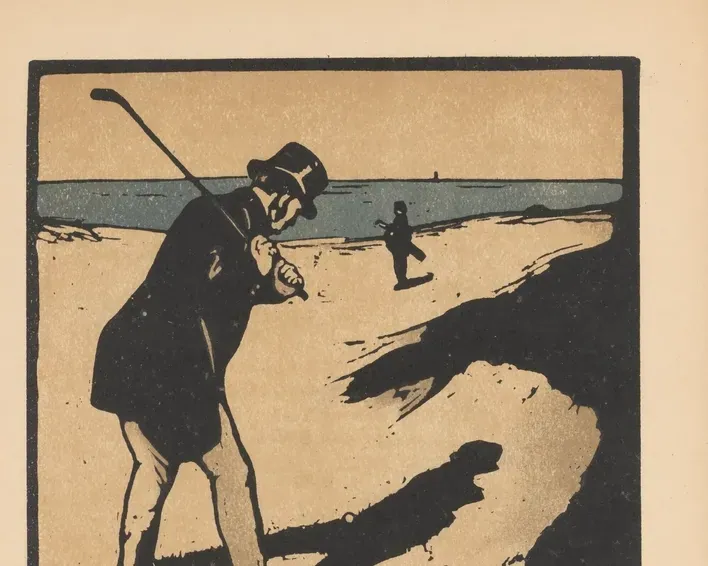
In 1905, when he published The Complete Golfer, Harry Vardon was the most famous golfer in the world. He had won the Open Championship four times and the United States Open once, during a tour of America in 1900. He would go on to win two more Opens, in 1911 and 1914, a record six that still stands. Today the Vardon Trophy, awarded by the PGA of America for the lowest scoring average on the PGA Tour, carries his name.
His book is a strange and lovable thing: half autobiography, half instruction manual, written in a voice that is modest, practical and occasionally very funny. It is all in the Library, and it repays reading even if you never intend to use a brassy or a cleek.
A boy from Grouville
Vardon begins at the beginning. He was born, he tells us, “on May 9, 1870,” in Grouville, on the island of Jersey, “a collection of scattered cottages and farmhouses a few miles from St. Heliers.” His father was a gardener, and there were eight children. When golfers from England laid out a course on the common near his home, the local boys became caddies, and then players, making their own clubs and playing, as the summary of his opening chapter puts it, “Matches in the moonlight.”
By his own account he never had a single lesson. He became a gardener himself, played whenever he could, and only turned professional after his brother Tom did well in a tournament at Musselburgh. Thereupon, he writes, he concluded that “if Tom could do that, then I too with a little patience might do the same.” His first professional job was at a new nine-hole course at Ripon, in Yorkshire. He was twenty.
The grip
The most lasting thing Vardon gave the game is the grip that now bears his name. He did not invent it, but he made it famous, and his description is still clear today. In “Driving: Preliminaries” he explains that “the third finger completes the overlapping process, so that the club is held in the grip as if it were in a vice,” while “the little finger of the right hand rides on the first finger of the left.”
He is careful to distinguish it from the interlocking grip: “My grip is an overlapping, but not an interlocking one.” And he gives the best possible reason for using it: “both hands feel and act like one.” More than a century later, most golfers who have ever taken a lesson hold the club essentially as Vardon describes.
Practical wisdom
The instructional chapters cover everything from choosing clubs to escaping bunkers and putting. The equipment is from another world, but the advice about balance, rhythm and keeping calm is timeless. Vardon is especially good on the mental side of the game: on nerves, on concentration, and on playing the course rather than the opponent.
There are also chapters that open windows onto a vanished golfing life: on caddies, on golf for ladies, and on his impressions of golf in America at the turn of the century, when the game there was young and growing fast.
The joy of it
What makes the book more than a museum piece is Vardon’s obvious love of the game. He describes the days “when everything has gone right and nothing wrong,” when “The little white ball has seemed possessed of a soul—a soul full of kindness and the desire for doing good.” Every golfer has had a day like that, and every golfer has spent years chasing the next one.
He ends his second chapter with a line that could stand as a motto for anyone who has played the game for a long time: “it takes longer to kill the golf in a man than it does to breed it.”
How to read it
Start with the first two chapters, which tell Vardon’s story, then dip into whatever interests you. The final chapter, “Reflections and Recollections,” is a lovely piece of writing on the great players and matches of his time. And when you have finished, read Wodehouse’s “The Clicking of Cuthbert,” in which a Russian novelist turns out to be desperate to meet “Arreevadon.” You will know exactly who he means.
More from The Library
See all
The first tee is a promise of a better day.
A century on, P.G. Wodehouse’s golf stories still read like dispatches from your own clubhouse — and they begin with a young man trying to give his clubs away.

A Golfer’s Bookshelf
Five classic golf books, free to read in full in the GolfProse Library — and where to begin with each.
The Oldest Member’s Guide to Love
In The Clicking of Cuthbert, Wodehouse’s clubhouse sage has firm views on romance — chiefly that it should never be allowed to interfere with a man’s short game.