Before Golf Was Golf
Dutch players on the ice, Scottish golfers in jail, and a Rembrandt etching. On the long, disputed and delightful prehistory of the game.
By GolfProse · · 3 min read
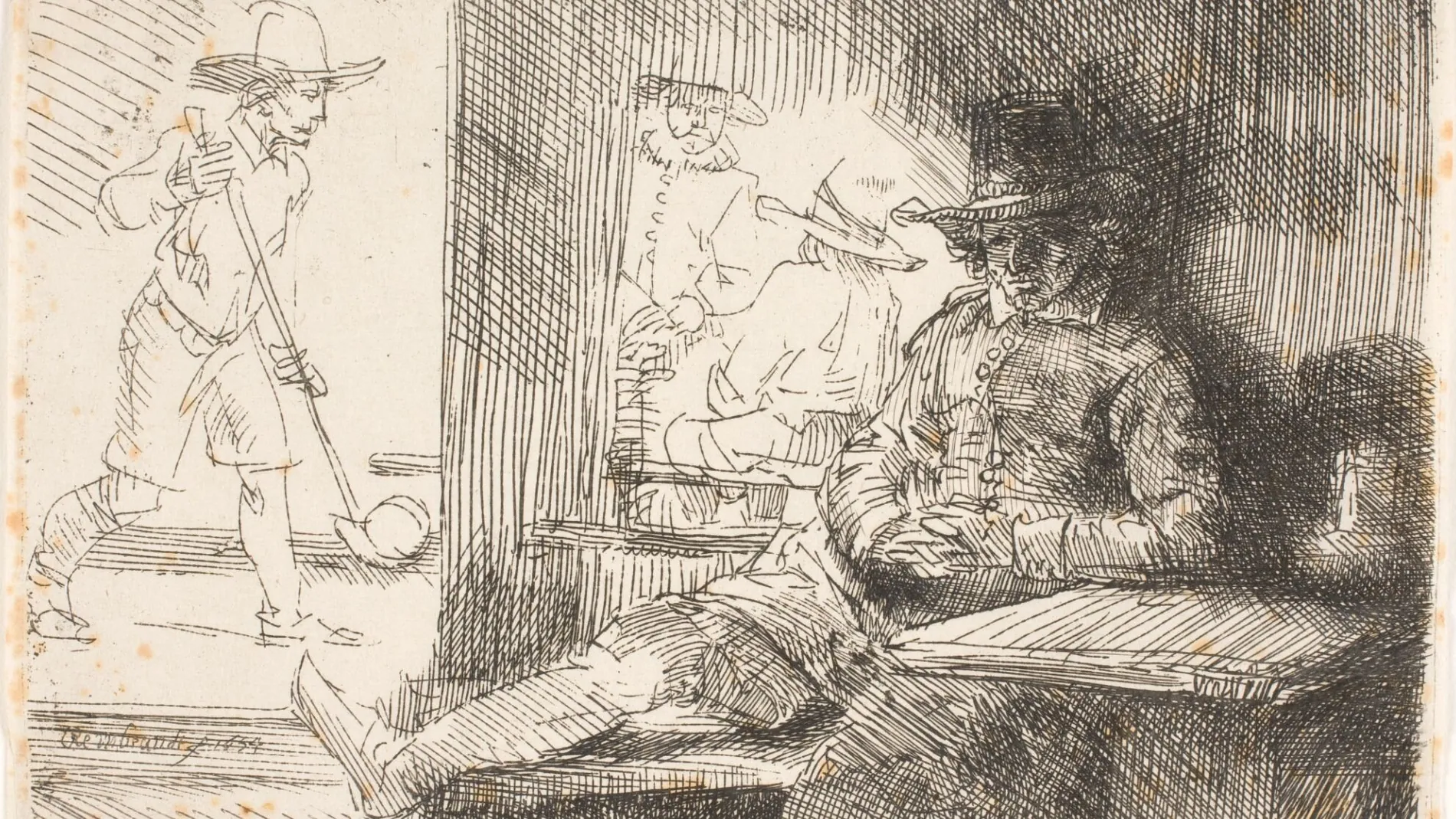
Nobody knows exactly where golf began, and that is part of its charm. The game has an official home in Scotland and an official history full of dates and documents, but around the edges of that history lies a much older and murkier world of stick-and-ball games played across fields, streets and frozen canals.
The Dutch game
In the Low Countries, people played a game called colf (later kolf) for centuries, hitting a ball with a club toward a target, sometimes over long distances through town and country, and very often on ice. Seventeenth-century Dutch winter landscapes are full of tiny figures with clubs, playing among the skaters on frozen rivers and canals.
Rembrandt made an etching of a kolf player in 1654. It is a small, informal picture: in the foreground a man sits at a table by a doorway, while outside, almost in silhouette, a player stands with his club and ball. It is not a dramatic scene. It is simply ordinary life, a game being played outside an inn on an ordinary day, and that is what makes it precious. It tells us the game was everyday enough for one of the greatest artists who ever lived to sketch it in passing.
Whether the Dutch game is an ancestor of golf, a cousin, or simply a parallel invention is still argued over by historians. What is certain is that Scotland and the Netherlands traded constantly across the North Sea, and that the idea of hitting a ball with a crooked stick toward a distant mark was in the air on both sides of it.
Trouble in Scotland
The Scottish records, when they appear, are wonderfully disapproving. In the fifteenth century the Scottish Parliament complained that golf and football were distracting men from archery practice, which was needed for the defence of the realm, and ordered the games to be stopped. The order does not seem to have worked.
Later, the Church took up the complaint. P.G. Wodehouse dedicated The Clicking of Cuthbert “to the immortal memory” of two Edinburgh men, John Henrie and Pat Rogie, who in 1593 were imprisoned for “playing of the gowff on the links of Leith every Sabbath the time of the sermonses.” Wodehouse, an enthusiastic golfer with a gift for mock-heroic language, clearly regarded them as martyrs.
The comic version
Wodehouse also offered his own account of how golf began, and it is far more entertaining than the real one. In “The Coming of Gowf,” the last story in The Clicking of Cuthbert, he takes us to an ancient kingdom ruled by King Merolchazzar of Oom, a lovesick monarch whose courtship of a neighbouring princess has stalled. What happens when the king discovers the game is best discovered for yourself, but it involves a captive Scotsman carried off from a place the locals call “S’nandrews,” a royal conversion, and a very modern set of golfing anxieties transplanted into antiquity.
The joke, as always with Wodehouse, contains a truth. The emotions of golf, the hope, the obsession, the conviction that one small adjustment will put everything right, feel so old and so universal that it is easy to imagine them in any century.
Why the prehistory matters
It would be tidy if golf had a single inventor and a single birthplace. It doesn’t. It grew, like most good things, out of many people in many places hitting balls toward targets for the pleasure of it. Shepherds, soldiers, merchants, children on frozen canals and men skipping church on the links of Leith all had a hand in it.
When you stand on the first tee on a winter morning, with frost still on the fairway and your breath hanging in the air, you are closer to that Dutch canal than you might think. The equipment has changed. The game hasn’t, very much.
More from People & History
See all
The Spirit of the Early Amateurs
Talent, character and a different kind of greatness. What the golfers of a century ago can still teach us about playing for the love of it.
Vardon in America
In 1900 the greatest golfer in the world spent the best part of a year touring the United States. He came home with a national championship, a sheaf of newspaper cuttings and a firm conviction that the young American game was going places.
The Great Match: Vardon v. Park
Seven thousand spectators, two referees, a pair of signal flags and £100 a side. Harry Vardon’s own account of the challenge match he called the event of his lifetime.