Charles Van Loan and the American Locker Room
Four years before The Clicking of Cuthbert, an American sportswriter was filling the country-club locker room with slow foursomes, sharp old men and golfers who swear they’ll never play again.
By GolfProse · · 5 min read
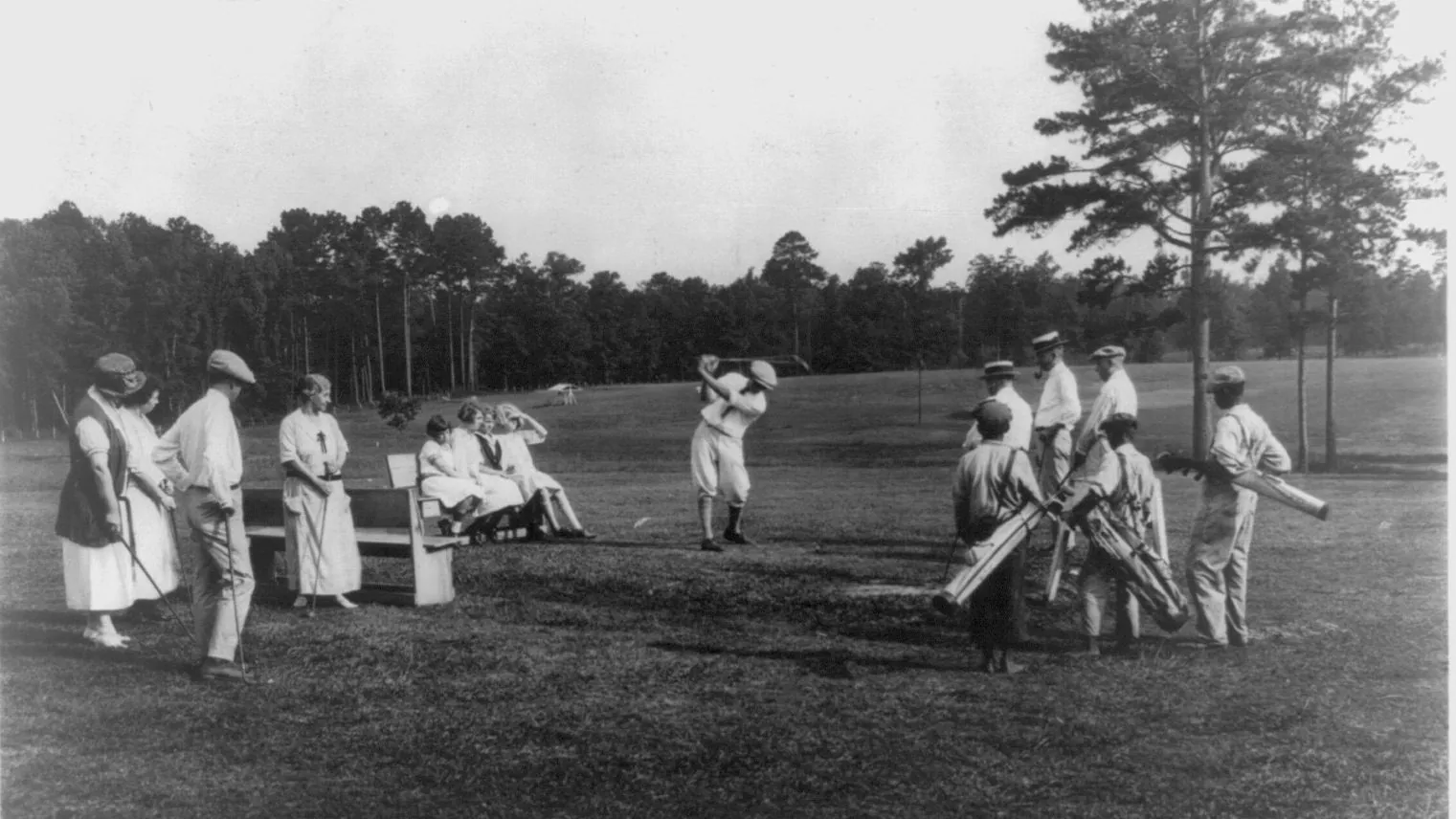
If Wodehouse’s golf stories belong to the smoking-room, with its leather chairs and its sage in the corner, Charles E. Van Loan’s belong to the locker room. You can hear the showers running and the steel doors banging. Someone is complaining about his slice, someone else is telling a joke everyone has heard, and in the lounge next door two old men are working out how much they can take off the new member.
Fore! came out in 1918, four years before The Clicking of Cuthbert, and its nine stories are now free to read in the Library. Van Loan was a sportswriter by trade, and he writes like one: fast, slangy and full of the noise of people talking at once. Where Wodehouse’s golfers are English gentlemen with a capital-G view of the game, Van Loan’s are American businessmen, bankers, lawyers and retired capitalists who play the way they work. They play hard, they gamble on everything, and they always want to know the odds.
The voice
Several of the stories are told by a club member who was there, in a conversational voice that buttonholes the reader from the first line. Van Loan loves the comic catalogue, the build-up of grievance, and the expert who wants you to understand he knows exactly what he is talking about. His description of the classic slow foursome in “Gentlemen, You Can’t Go Through!” runs for a full paragraph of glorious exaggeration, ending with the claim that “a rheumatic snail could give them a flying start and beat them out in a fifty-yard dash.”
It is the voice of a man who has been held up on the seventh tee more times than he can count, and is finally getting it off his chest.
The slow foursome
That first story is the natural place to start. The Sundown Golf and Country Club is in the grip of the Big Four, Watlington, Peck, Peebles and Hamilton, four rich old men who founded the club, sit on every committee, play every Wednesday and Saturday, and in seven years have never once let anyone through. Between them, as it happens, they also own the Midland Manufacturing Company.
Into this arrives Wally Wallace, home from college with a six handicap, a great deal of money and rather more chin than he needs. Playing a tournament match with the narrator, a ten-handicap lawyer named Curtiss, he runs into the Big Four, bets a string of fellow members that he can get them to let him through, and is flatly refused. Before he walks off, he tells the committee exactly what he thinks of them: “Golf is a gentleman’s game, which doubtless accounts for your playing it so poorly.” Then he promises that one day they will beg people to play through.
How he keeps that promise has nothing to do with golf, and everything to do with how American city politics worked. It is a revenge story with a very satisfying ending, and we won’t spoil it.
The Ooley-cow
“The Ooley-Cow” is perhaps the best story in the book. Wesley J. Perkins is a slow, soft-eyed and very wealthy man from Dubuque, Iowa, which he insists on calling the Heidelberg of America. He has moved to Southern California and taken up golf for his waistline. The club nicknames him the Ooley-cow because, as the narrator explains, “Perkins not only looks like a cow and walks like a cow and plays golf like a cow.”
He falls straight into the hands of Uncle Billy Poindexter and Old Man Sprott, two retired capitalists who pretend to be doddering invalids while fleecing every beginner in the club. Van Loan sums them up nicely: “Taking into account the natural limitations of age they play golf very well, but they play a cinch even better—and harder.” Perkins pays for everything, balls, lunches, drinks and caddies, without a murmur, until the old sharks go one step too far with a trick involving his lost wallet.
Then an old friend of Perkins arrives from Iowa, a loud, boastful man who can barely hit the ball, and Uncle Billy and Sprott can scarcely believe their luck. The story’s punchline turns on a piece of farmyard wisdom about cows, and it is worth waiting for.
The man who quit
Van Loan is not only a writer of hustles and revenge plots. “The Man Who Quit” is a gentler and more truthful piece about something every golfer knows: the slump. Bob Coyne, a six-handicapper who has been breaking eighty, suddenly loses every shot he owns, is beaten by a left-handed hacker who will not stop talking about it, and in a fit of rage gives his entire set of clubs away to the caddies.
What follows is a quiet Sunday afternoon at home, a dull novel, an old rusty mid-iron in the back of a cupboard, and a dented ball the dog has been chewing. Van Loan’s observation about late converts is one Wodehouse would have recognised: “The man who does not learn to play any game until he is thirty years of age is quite capable of going daft over tiddledywinks or dominoes.” The story’s last laugh goes to Jasper, the locker-room attendant, who has seen a great many members quit. Modern readers should be warned that Van Loan writes Jasper’s speech in heavy period dialect, which has aged badly. But the character is the shrewdest person in the story, and he knows it.
Why read him now
Van Loan’s world is a long way off. There are sand greens and red flags, and Iowa fortunes looking for somewhere to retire. But his golfers are entirely familiar: the slow foursome, the club bore, the sandbagger with a suspiciously generous handicap, the man who swears he is finished with the game and is back on Monday morning. He understood that the clubhouse is a small society with its own laws, and that most of the drama of golf happens off the fairway.
He also brings something Wodehouse doesn’t, which is money. In Fore! there is almost always a bet on, and the stories are as much about the gamble as the game. It makes him the perfect companion to the Oldest Member: brasher, faster, more cynical, and every bit as fond of the people he is laughing at.
If you have read our guide, “A Golfer’s Bookshelf,” you will know where Van Loan sits in the Library. Start with the slow foursome, go on to the Ooley-cow, and keep “The Man Who Quit” for the next time your own game deserts you. It will be back. As Jasper could tell you, they always come back.
More from The Library
See all
The first tee is a promise of a better day.
A century on, P.G. Wodehouse’s golf stories still read like dispatches from your own clubhouse — and they begin with a young man trying to give his clubs away.

A Golfer’s Bookshelf
Five classic golf books, free to read in full in the GolfProse Library — and where to begin with each.
Harry Vardon’s Lessons, a Century On
The greatest golfer of his age grew up making clubs from hawthorn in Jersey. His book is part memoir, part manual, and still full of good sense.