The first tee is a promise of a better day.
A century on, P.G. Wodehouse’s golf stories still read like dispatches from your own clubhouse — and they begin with a young man trying to give his clubs away.
By GolfProse · · 3 min read

Every round begins with a small act of faith. You stand on the first tee, the fairway laid out ahead like an unwritten page, and for a moment anything is possible. Last week’s slice has been forgiven. The putter that betrayed you has been spoken to. This, you tell yourself, is the day it all comes together.
P.G. Wodehouse understood that feeling better than any writer before or since. He came to golf as an adult, and in the preface to The Clicking of Cuthbert, his first book of golf stories, published in 1922, he describes himself as “an eighteen-handicap man who has got to look extremely slippy if he doesn’t want to find himself in the twenties again.” The book, he claims, “is written in blood.”
It is, of course, nothing of the kind. It is one of the funniest books ever written about a game, and it is all free to read in the Library.
The Oldest Member
Most of the stories are told by the same narrator: the Oldest Member, a clubhouse sage who no longer plays but has forgotten nothing. He sits in the smoking-room with his pipe, waiting for a younger member to come in with a grievance, and then he begins. The very first story introduces him gazing through the smoke at a young man who has just announced he is giving up the game. His eye, Wodehouse tells us, “was deep and dreamy—the eye of a man who, as the poet says, has seen Golf steadily and seen it whole.”
The poet is Matthew Arnold, who wrote of a man who “saw life steadily, and saw it whole.” Wodehouse simply swaps life for Golf, with a capital G, and the whole philosophy of the book is there in a single joke. To the Oldest Member, golf is not a pastime. It is the measure of a man’s character, the test of a marriage, and the answer to most of life’s questions.
Cuthbert and the Russian novelist
The title story is a perfect place to start. Cuthbert Banks is a superb golfer and a hopeless conversationalist. He falls for Adeline Smethurst, the niece of the woman who runs the Wood Hills Literary Society, and Adeline has no use for golf. She prefers Raymond Parsloe Devine, a rising young novelist. So Cuthbert, desperate, takes to attending the Society’s meetings, where he sits through lectures he cannot follow and dreads being asked his opinion of modern Russian fiction.
Then the great Russian novelist Vladimir Brusiloff arrives as guest of honour, and complains that he has met England’s politicians but not its real great men — “your Arbmishel, your Arreevadon.” The Literary Society is baffled. Only Cuthbert understands: Brusiloff means Abe Mitchell and Harry Vardon, two of the finest golfers of the day.
We won’t spoil what happens next, except to say that the man who knows golf turns out to be the only person in the room worth talking to. It is a joke at the expense of literary pretension, but it is also a quiet manifesto. Wodehouse is on the side of the people who play.
And if you want to meet the real Arreevadon, his own book, The Complete Golfer, is on the shelf beside it.
Why it still works
Wodehouse’s golf has hickory shafts and plus-fours, but nothing essential has changed. His golfers still blame their equipment, still believe a new grip will transform their game, and still fall in love with people who don’t understand why anyone would spend four hours walking after a small white ball. The hopeful duffer, the impossibly smooth rival, and the partner who talks on your backswing are all still at your club. Wodehouse just describes them better than anyone else.
He also understood that golf is fundamentally a hopeful game. Every story is, in its way, about the first tee: about the moment before the shot, when the bad rounds are behind you and the good one is surely coming. The Oldest Member has watched a lifetime of those moments, and he never seems to tire of them.
How to read it
The stories are each about twenty minutes long, which makes them ideal for an evening or a rain delay. Start with “The Clicking of Cuthbert”, then try “The Long Hole,” a single hole played from the first tee to the doorway of a hotel in town, some sixteen miles away, and finish with “The Coming of Gowf,” Wodehouse’s mock history of how the game began. When you’ve finished, his second collection, The Heart of a Goof, is waiting.
The first tee is a promise of a better day. Wodehouse kept that promise for half a century, and on the page he keeps it still.
More from The Library
See all
A Golfer’s Bookshelf
Five classic golf books, free to read in full in the GolfProse Library — and where to begin with each.
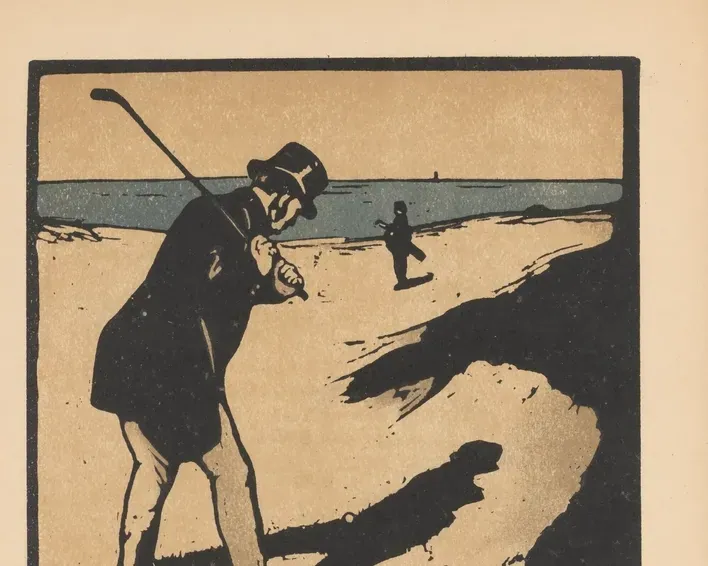
Harry Vardon’s Lessons, a Century On
The greatest golfer of his age grew up making clubs from hawthorn in Jersey. His book is part memoir, part manual, and still full of good sense.
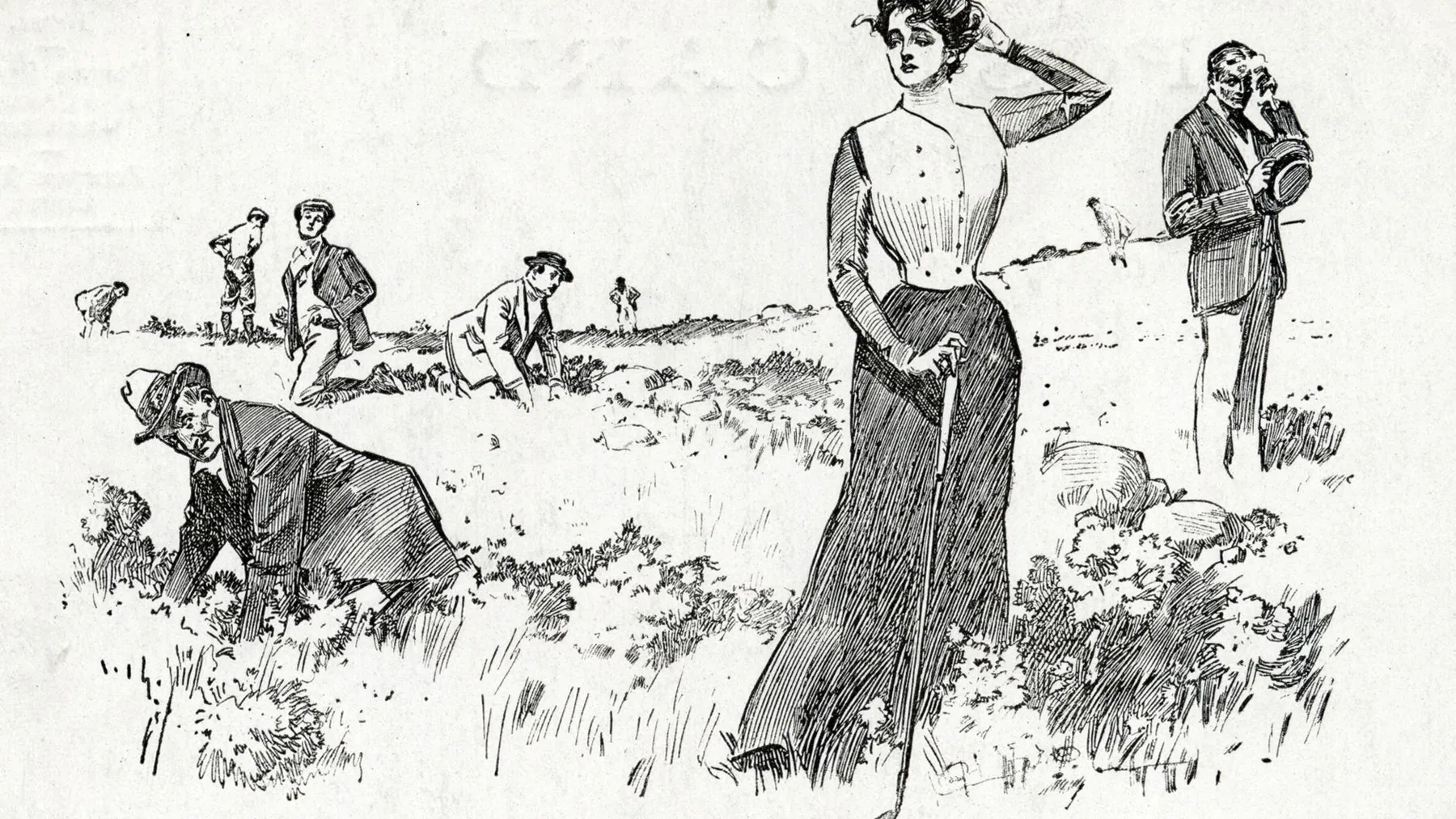
The Oldest Member’s Guide to Love
In The Clicking of Cuthbert, Wodehouse’s clubhouse sage has firm views on romance — chiefly that it should never be allowed to interfere with a man’s short game.