The Magic of Plus Fours
Can a pair of trousers make you a better golfer? P.G. Wodehouse thought it worth a story, and the question has never quite gone away. On dressing for the game.
By GolfProse · · 5 min read
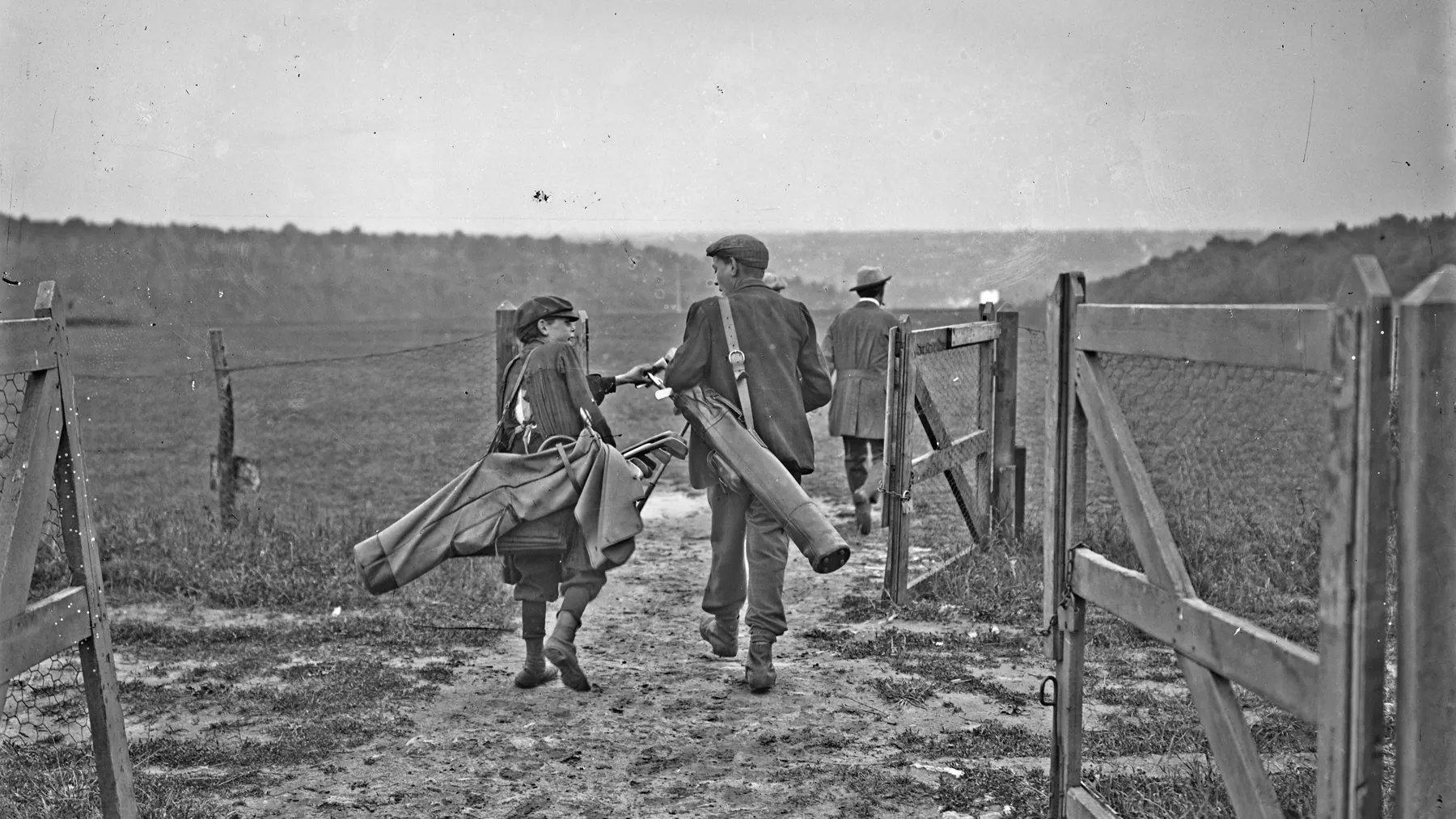
Every golfer has, at some point, bought something in the hope that it would help. A new driver, a new putter, a new glove. Fewer will admit to buying a pair of trousers for the same reason, but the feeling is the same, and P.G. Wodehouse understood it perfectly.
His story “The Magic Plus Fours” is about a young man called Wallace Chesney, handsome, rich, engaged to the delightful Charlotte Dix, and one of the worst golfers in the club. He is kept modest, the Oldest Member explains, entirely by his golf. What he lacks is confidence, and he has tried everything to find it: patent clubs, golf books, even repeating a cheerful phrase to himself fifty times every morning.
A miracle in a second-hand shop
Then, one spring morning, he wanders into a second-hand clothier’s in the City to buy a putter, and the brothers who run the place sell him rather more than he came for. Among the extras is a pair of plus fours, supposedly made for an Open Champion and sent back. They are a vivid pink, overlaid with squares of white, yellow, violet and green. Wallace’s first reaction is horror. His second, as he looks in the glass, is something much more dangerous.
Wodehouse gives us the revelation in one of his best sentences: “He saw now—what he had never seen before—that it was not because they were crack players that crack players wore Plus Fours: it was because they wore Plus Fours that they were crack players.”
The club is appalled. Charlotte begs him to change, protesting that “There must be a rule somewhere in the book against coming out looking like a sunset.” But the breeches work. Within a week the other members have grown used to them, and within a few months Wallace is plus two, a contender for the July medal, and quite insufferable. He lectures his partners, sneers at their tee shots, and loses Charlotte.
The cure, when it comes, is pure Wodehouse. A match-box, a wasp, a slap from his playing partner and a sudden leap into the lake. Back in his old grey flannels, Wallace cannot hit a ball over the water to save his life, and is happier than he has been in months. He has rediscovered what he had lost: “That was the soul of golf, the thing that made it the wonderful pursuit it was—that speculativeness, that not knowing where the dickens your ball was going when you hit it.”
What the story gets right
It is a comic tale, but it is not wrong about clothes. What Wallace finds in the Cohen brothers’ mirror is not skill but belief, and belief is a large part of golf. Most of us play a little better when we feel we look the part, and a little worse when we feel conspicuous. The trick is to dress so that you can forget what you are wearing.
That is not a new idea. Golf has always borrowed its clothes from somewhere else. The early players at Blackheath, as Bernard Darwin notes in his account of the London courses, were painted in great finery: “the gentleman in a red coat with blue facings, gold epaulettes and knee-breeches.” Later came tweed and knickerbockers, the ordinary dress of a country gentleman out for a long walk. Plus fours themselves are usually said to take their name from the four extra inches of cloth that let the breeches hang loose below the knee, which gave the legs room to move and kept the trousers out of the wet grass.
Vardon’s tailoring
Harry Vardon, who knew a thing or two about swinging a club, was firm on the subject. In the miscellany of advice in The Complete Golfer he warns: “Do not wear too tightly fitting clothes. Particularly be careful to see that there is plenty of spare cloth under the arms.”
It is a nice echo of Wodehouse, whose shopkeepers squeeze Wallace into a yellow tweed suit with a shoe-horn and assure him it will give. Vardon’s other counsel is of its time. He preferred braces to a belt, shoes to boots, and kept his jacket on even on the warmest day. Few of us would follow him all the way. But the principle underneath is sound: clothes for golf should let you turn freely, keep you comfortable for four hours, and never once remind you they are there.
A few timeless rules
If there is a philosophy of golf clothing worth holding to, it is something like this.
Dress for the weather, not the catalogue. Layers you can add or remove will serve you better than any single garment. A good wool sweater is still the most useful thing a golfer can own.
Freedom first. Check the shoulders and the arms before you check the mirror. If you cannot make a full turn in it, it is not golf clothing, however it looks.
Look after your feet. You will walk several miles. Comfortable, well-kept shoes matter more than anything else you wear.
Respect the club. Every course has its customs. Learning them, and quietly following them, is part of being a good guest.
Let personality in, a little. A bright sweater, a favourite cap, even a daring pair of breeches can be a joy, provided you wear them for pleasure rather than as a magic charm.
The moral of the breeches
Wodehouse leaves the plus fours charred and dripping under a bush by the eleventh tee, looking, as he puts it, sullen and baffled. They had done their work too well. They gave Wallace a golf swing and took away the fun.
There is a lesson there for anyone who has ever bought something to fix their game. Wear what makes you comfortable and cheerful, play in it with friends, and keep a sense of humour about your slice. The best thing a golfer can put on is not a pair of trousers at all. It is the cheerful readiness to commiserate with your opponent and mean it, which, as Wallace discovers, is worth more than any number of strokes off your handicap. For more on the small rituals of the game, see the pleasure of good company.
More from The Good Life
See all
The 19th Hole
On good food, great company and the traditions that make the clubhouse the best part of the day for so many golfers.
The pleasure of good company.
Polished shoes, a favourite sweater, a partner who knows when to say nothing. On the small rituals that make a round worth remembering.
In Praise of the Caddie
Silent counsellor, blunt critic, keeper of the club’s best stories. Harry Vardon had firm views on what makes a good caddie, and most of them still hold.