In Praise of the Caddie
Silent counsellor, blunt critic, keeper of the club’s best stories. Harry Vardon had firm views on what makes a good caddie, and most of them still hold.
By GolfProse · · 5 min read
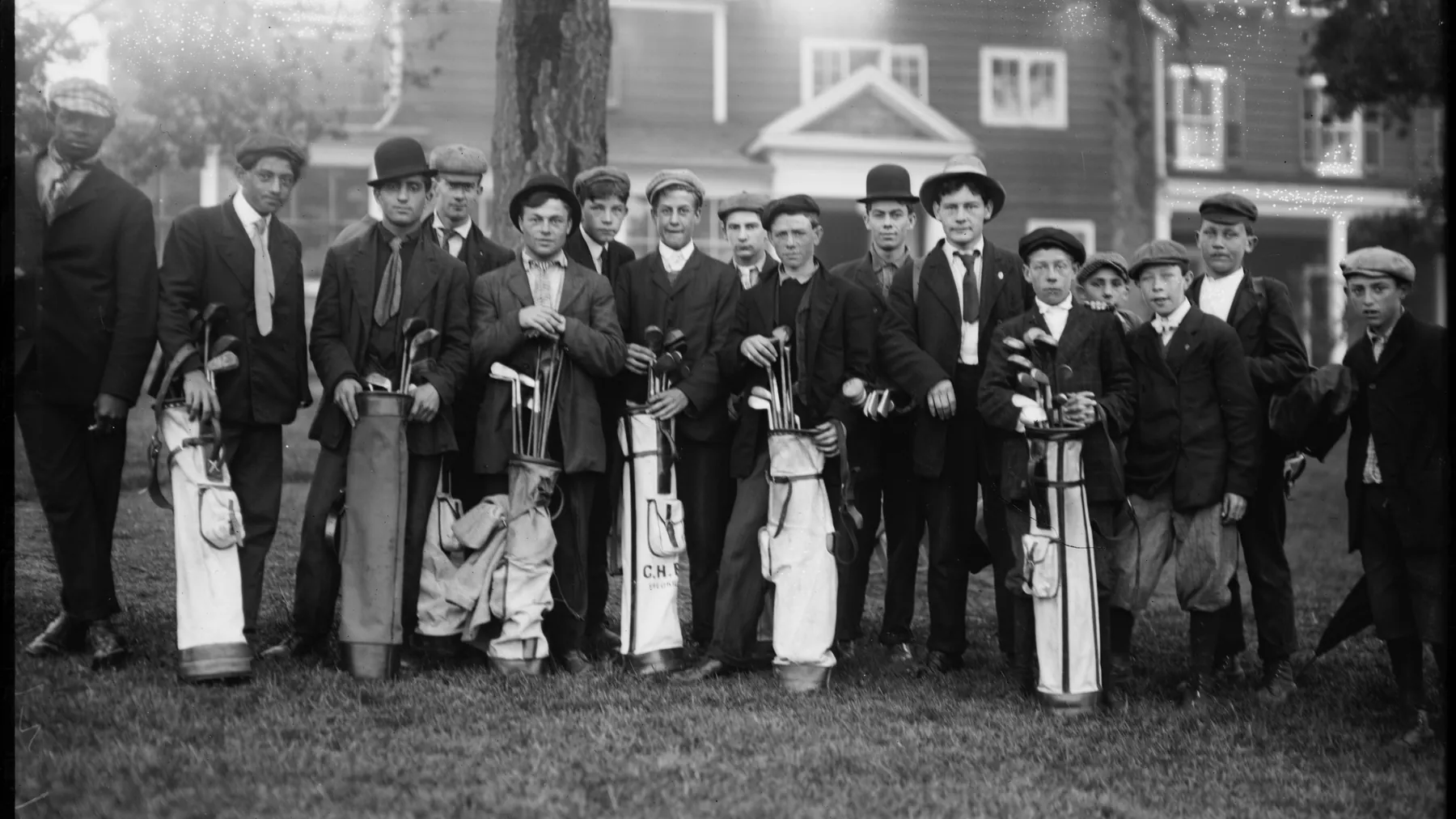
Most golfers today carry their own clubs, or wheel them along behind on a trolley. That is a perfectly sensible way to play. But something was lost when the caddie became a rarity, and anyone who has had the luck to play a round with a good one will know what it was.
Harry Vardon, six times Open Champion, spent his life in the company of caddies, and in The Complete Golfer he gave them a whole chapter. It begins with a plain statement of fact: “The caddie is an indispensable adjunct to the game of golf.” It then becomes one of the funniest and most affectionate things he ever wrote.
Too little, and too much
Vardon divided caddies, roughly, into those who know too little and those who know too much, and he was not sure which was worse. In the first class he puts the fisherman drafted in on a busy day at North Berwick, who watched a left-handed golfer take his stance and told him loudly that he was standing on the wrong side of the ball. And the boy at Ganton who, struck on the head by a wayward shot and consoled with half a sovereign, dried his tears at once and asked whether the gentleman would be coming out again that week.
In the second class is the caddie who carried for Vardon in a championship and swore at him all the way round, even though he was leading. When Vardon missed a short putt, the boy let him know exactly what he thought of a man who could hit the flag but not hole out. He asked to carry for Vardon many times afterwards. He was always refused.
The silent caddie
Vardon’s ideal is drawn with real tenderness. He wants a caddie who knows the course and the game, who has the right club ready before he is asked, and who otherwise keeps quiet. “This caddie is a silent caddie, who knows that words of his are out of place, and that they would only tend to upset his master’s game.”
He goes on to describe the perfect partnership. The player studies the shot, puts out his hand without looking, and feels it close on exactly the club he wanted. The shot is played, and the two walk on together. On the green the caddie is already at the pin. After a missed putt he says nothing at all, and after a great one he allows himself a few words of congratulation.
There is a lovely passage, too, on girl caddies, whom Vardon had met on links up and down the country and found uncommonly good: watchful, quiet, never keeping the player waiting, and wise enough, when the choice of club was genuinely doubtful, to hold out the bag and let the golfer decide. In one of his last matches of the previous season, at Luton, he had a girl carry for him, and she was as good as any.
The caustic tongue
Not every caddie was silent, and Vardon would have been sorry if they were. The chapter is full of their dry northern humour. There is the caddie at a Scottish green who watched a visitor carve great holes in the turf with his irons until he could bear it no longer and begged him to have mercy on poor old Scotland. There is the boy at Luffness who begged his master to do his very best on the last hole because there was money on the match, and who, when the hole was lost and the golfer kindly offered to make good the wager, confessed that it had been a penny.
Vardon’s conclusion is gentle: no player is great in the eyes of his caddie. It is meant as praise. The caddie’s standards are high because he wants you to meet them.
Good human kindness
Under the sarcasm, Vardon insists, there is a great deal of warmth. His favourite example is “Big Crawford,” who was carrying for Mr. Balfour on the day he played himself into the captaincy of the Royal and Ancient. Hearing a spectator ask whether anyone was looking after the great man now, Crawford turned and answered: “Aw’m lookin’ aifter Maister Balfour.”
And there is Sandy Smith, carrying for a player who was six holes up and still trying to claim a disputed hole. Sandy rounded on his own employer: “Haud yer tongue, sir; haud yer tongue. Wad ye break the man’s heart?” A caddie, in other words, who cared more about the decency of the game than about winning it.
P.G. Wodehouse, who knew the old customs well, makes the caddie’s authority part of the furniture of the game. In “The Magic Plus Fours” the Oldest Member reminds us that “One of the cardinal rules of golf is that a player shall accept no advice from any one but his own caddie,” a rule his hero breaks only because his trousers are on fire.
Advice, and when to ignore it
Vardon was not starry-eyed. In his general hints he warns against following a caddie’s advice when you are sure it is wrong, since a shot played without conviction rarely comes off, and he reminds the player that the caddie’s ideas are often borrowed from watching scratch men. He also warns against ordering your opponent’s caddie about as if you were paying him. And he insists that seeing your divots replaced, by your caddie or by yourself, is a golfer’s first duty.
The caddie now
The caddie has not disappeared. At the great old links and on the professional tours, he is still there, reading greens, pacing yardages and carrying the bag through wind and rain. Many clubs still have a few, and taking one for a round, especially on a course you do not know, is one of the small luxuries of the game. You will learn more about the course in four hours than you would in four visits.
If you do, remember Vardon’s ideal. Let the caddie do the job. Ask when you want advice, and listen when you get it. Thank them properly at the end. And, if you have been playing badly, take some comfort from Vardon’s last story: the faithful caddie in the sheds after a disastrous day, polishing his master’s clubs more carefully than ever because, as instructed, he must then break them across his knee and throw them in the river.
The best caddies have always known that golf is about more than the score. Like good company, they make the walk worth taking.
More from The Good Life
See all
The 19th Hole
On good food, great company and the traditions that make the clubhouse the best part of the day for so many golfers.

The pleasure of good company.
Polished shoes, a favourite sweater, a partner who knows when to say nothing. On the small rituals that make a round worth remembering.
The Magic of Plus Fours
Can a pair of trousers make you a better golfer? P.G. Wodehouse thought it worth a story, and the question has never quite gone away. On dressing for the game.