The Links of Ireland in 1910
Cunning bunkers at Dollymount, a boat crossing to Portmarnock, champagne air at Portrush and the mountains above Newcastle. Bernard Darwin’s Irish chapter is one of the happiest in his book.
By GolfProse · · 5 min read
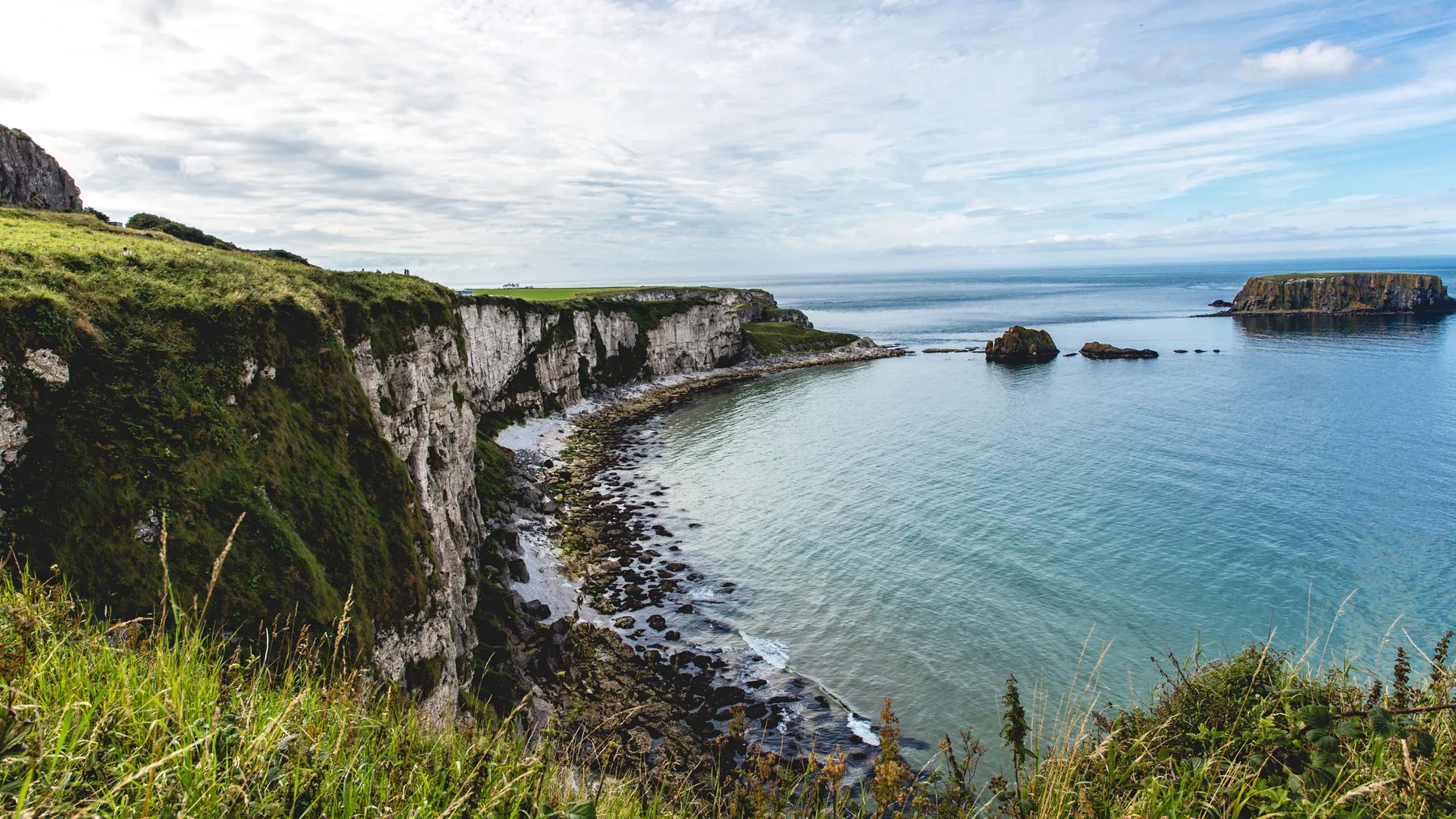
Some chapters of Bernard Darwin’s The Golf Courses of the British Isles read like careful surveys. The chapter on Ireland reads like a man remembering a series of very good holidays.
He came to Irish golf, he explains, mostly as a member of two touring sides, the English Bar and the Oxford and Cambridge Golfing Society, who crossed the Irish Sea from time to time to enjoy Dublin’s hospitality. He never forgot the welcome. In Ireland, he writes, “the friendliness with which the inhabitants welcome their guests is only equalled by the earnestness with which they endeavour, and very often successfully, to beat them.”
What follows is Ireland as Darwin knew it in 1910. Several of the courses he describes had just been altered, and all of them have changed since.
Dollymount and its little pots
Of the two great Dublin courses, Darwin seems fondest of Dollymount, reached by a long causeway. He had played many hard matches there, and he confesses that, “save possibly at St. Andrews, I feel as if I had been in more bunkers at Dollymount than on any other course.”
The reason was the club secretary, Mr Barcroft, a devoted follower of John Low’s ideas about bunkers. He had read Low’s book Concerning Golf and then gone out with a shovel. The big hills at Dollymount were not what frightened players, Darwin says. It was the small, harmless-looking pot bunkers.
At first sight the course reminded him of Hoylake: flat, bare, even dull. That impression did not survive the first few holes, where neat fours kept turning into fives. He singles out the eighth, a dog-leg where everything tempts the golfer to slice but the approach only opens up for one who keeps resolutely to the left. Then there was the long, narrow seventeenth, played along a hog’s back with marsh on one side and rough on the other, to a green full of awkward curves. Darwin remembered two nervy short putts there in close matches, and both times the ball crept in. He still shuddered at the memory.
Across the water to Portmarnock
Portmarnock was reached by car across the wet sand at low tide, or by sailing boat when the tide was in. Darwin’s last crossing was by boat in a snowstorm, which he did not enjoy. In good weather, though, the little voyage was part of the charm. “There is an element of romance in playing golf even on a temporarily sea-girt island,” he writes.
Portmarnock’s great glory was its greens: true, and fast without being untrue, which he thought a rare virtue. Even on a raw Easter day they asked for the ball to be coaxed towards the hole rather than struck. He passes on a story he had read of a Scottish professional who reached the first green in two perfect shots and took seven.
He was careful to add that the course did not live on its greens alone. It was long and bold, had recently been lengthened around the sixth and seventh, and its best holes ran along winding gullies between the hills, like the fourth. He was fond of the twelfth, a blind pitch into a crater green, and he called Portmarnock a place to leave with real regret, even in a snowstorm.
Lahinch and the little course at Macamish
Darwin only mentions Lahinch, in County Clare, but warmly. Its holes were rather too blind, he admits, but the golf was hugely enjoyable. He quotes an English amateur who said it might not be the best golf in the world, but it was the golf he most liked to play.
In Donegal he lists Buncrana on Lough Swilly, Rosapenna and lovely Portsalon. Then he puts in a word for a tiny nine-hole course at Macamish, also on Lough Swilly, reached by boat or by a long, rough road. The holes crossed and recrossed each other, everyone played towards his own flag with little regard for anyone else, and it was dangerous if more than a handful of people were out. Darwin adored it. “For pure, unadulterated fun I have yet to see the equal of this course.”
Portrush on its promontory
For serious golf, Darwin sends the reader to Portrush in County Antrim. He notes that it had produced a remarkable line of women champions, naming Miss Rhona Adair and Miss May Hezlet. He praises the air, which made a third round hard to resist, and passes on, strictly on a friend’s authority, the claim that it let you drink a bottle of champagne every night and feel the better for it.
The setting was splendid, with the White Rocks and Dunluce Castle to the east and the hills of Inishowen to the west. True to the best seaside tradition, though, you could hardly see any of it from the course. “Who, for instance, ever heard of a self-respecting sea-side course where one could get a view of the sea!” he asks.
The first hole he thought almost too good to come so early in a match. The best golf came after the eleventh, among big hills and valleys: the blind short thirteenth and the fourteenth, the famous Long Valley, once deep in soft moss and by then as hard as St Andrews in August. He mourned the old seventeenth, lost to the fashion for length, a short hole over an enormous bunker. He tells of two players so frightened by the sight of it that they cut their stake from ten pounds to a shilling.
Harry Vardon agreed about Portrush. In The Complete Golfer he named it among the very best places for a golfing holiday.
Newcastle under the mountains
Darwin’s tour ends at Newcastle in County Down, under Slieve Donard, the highest of the Mourne Mountains, with the sea close enough to reach from the first tee. It had always been loved as a wonderful natural course, though he hints that this was a polite way of avoiding the question of how good it was. Newly lengthened, it was by then long enough for anyone. One distinguished player told Darwin he had never hit so many brassey shots in his life.
He picks out the sixth, a one-shot hole to a high plateau green whose sides fell steeply away, and the sixteenth, a huge carry from a high tee over an enormous bunker to a green perched on the far side. He closes the chapter by calling Newcastle one of the pleasantest places for golf in all Ireland, a fitting end to a chapter full of good times.
More from Places
See all
The Courses of Bernard Darwin’s 1910 Guide
The 62 courses Darwin features in The Golf Courses of the British Isles, from Sandwich to Lahinch, grouped by region and linked to the chapter where he describes each one.
A Quiet Corner on the Coast
Every golfer has one course they love beyond reason. Bernard Darwin’s was a small links on the Welsh coast, and he wrote about it like a man coming home.
Where the fairway meets the sea.
Wind, sand and short grass by the shore: what makes seaside golf the oldest and still the most beguiling form of the game.