A Quiet Corner on the Coast
Every golfer has one course they love beyond reason. Bernard Darwin’s was a small links on the Welsh coast, and he wrote about it like a man coming home.
By GolfProse · · 3 min read
Most writing about golf courses is a kind of ranking. Which is the hardest, the most beautiful, the most exclusive, the one you must play before you die. It is useful, up to a point. But it misses the most important thing about the courses we love, which is that we rarely love them for any of those reasons.
Bernard Darwin understood this. In 1910, after more than two hundred pages surveying the great courses of the British Isles, he reached Wales, and abandoned any pretence of objectivity.
“The course that my soul loves best”
“There are several very excellent courses in Wales,” he begins the final chapter of his book, “but I am quite determined to put Aberdovey first—not that I make for it any claim that it is the best, not even on the strength of its alphabetical pre-eminence, but because it is the course that my soul loves best of all the courses in the world.”
Then he says something that every golfer knows to be true. “Every golfer has a course for which he feels some such blind and unreasoning affection.”
He goes on to describe the feeling exactly: packing the clubs “with a peculiar delight and care,” counting down the railway stations on the way, stepping out onto the platform “as excited as a schoolboy home for the holidays,” and being met by his own familiar caddie. It is one of the most tender passages in golf writing, and it is not really about Aberdovey at all. It is about the place each of us goes back to.
Nine flower pots on the marsh
Darwin could remember the very beginning of golf at Aberdovey in the early 1880s, when he was a small boy. He passes on what he calls “the true legend” of how it started: a Colonel Ruck, who had played some golf elsewhere, “borrowed nine flower pots from a lady in the village and cut nine holes on the marsh to put them in.”
It is a perfect origin story, and a reminder of how many of the great seaside courses began: not with an architect and a budget, but with a few enthusiasts, some suitable ground and whatever could be borrowed. Darwin goes on to describe how the course grew and changed over the years he knew it, with holes added, abandoned and reshaped, which is the life of most old links.
Finding your own
The courses we love beyond reason are rarely the famous ones. They are the place we learned to play, or the course near a holiday house, or a modest links where the wind always seems to blow from the sea and the clubhouse serves the same sandwiches it did twenty years ago. We know where every bunker is, which putts break toward the water, and where the rough hides balls. We have bad memories there as well as good ones, and somehow the bad ones have become fond too.
What these places give us is not a challenge but a kind of continuity. Each visit adds a layer to all the earlier ones. You play the same holes you played as a teenager, or with a parent, or with an old friend who no longer plays, and the round becomes a conversation with your own past.
Quiet corners
The coast is full of quiet courses like this: lesser-known links and clifftop nines where you can still walk on at short notice, where the honesty box sits by the first tee, and where the only crowd is the gulls. They will never appear in a ranking. They may be, for someone, the course their soul loves best.
Darwin’s Aberdovey has changed a great deal since 1910, as all courses do. But the feeling he describes has not changed at all. If you have a course like that, you already know. If you haven’t found it yet, keep looking. It is probably closer to the sea than you think.
More from Places
See all
The Courses of Bernard Darwin’s 1910 Guide
The 62 courses Darwin features in The Golf Courses of the British Isles, from Sandwich to Lahinch, grouped by region and linked to the chapter where he describes each one.
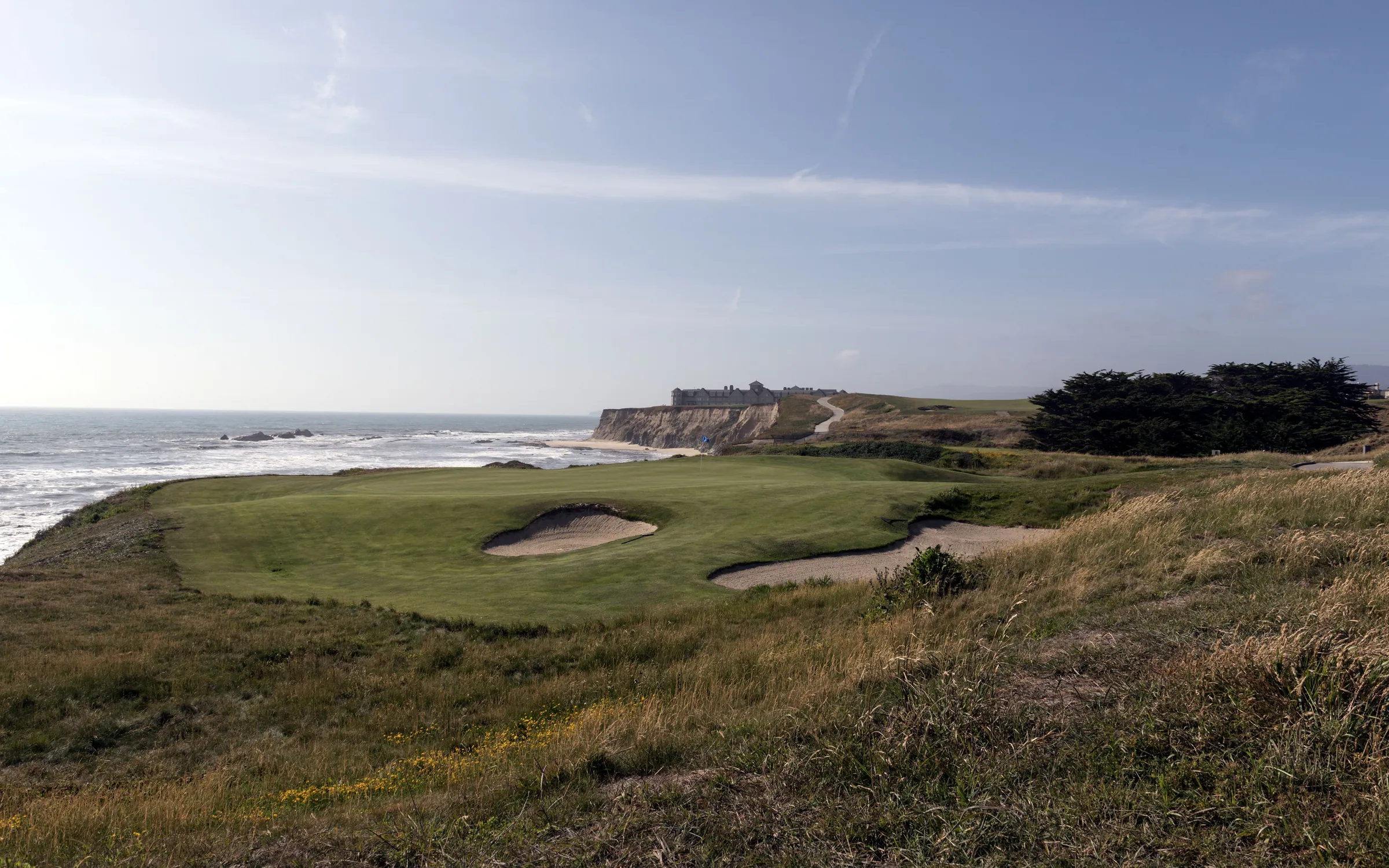
Where the fairway meets the sea.
Wind, sand and short grass by the shore: what makes seaside golf the oldest and still the most beguiling form of the game.
St Andrews Through Darwin’s Eyes
In 1910 Bernard Darwin walked the Old Course as an admiring pilgrim, bunker by bunker and plateau by plateau. His account is a portrait of a golfing town, and of a course that never once looked easy.