St Andrews Through Darwin’s Eyes
In 1910 Bernard Darwin walked the Old Course as an admiring pilgrim, bunker by bunker and plateau by plateau. His account is a portrait of a golfing town, and of a course that never once looked easy.
By GolfProse · · 5 min read
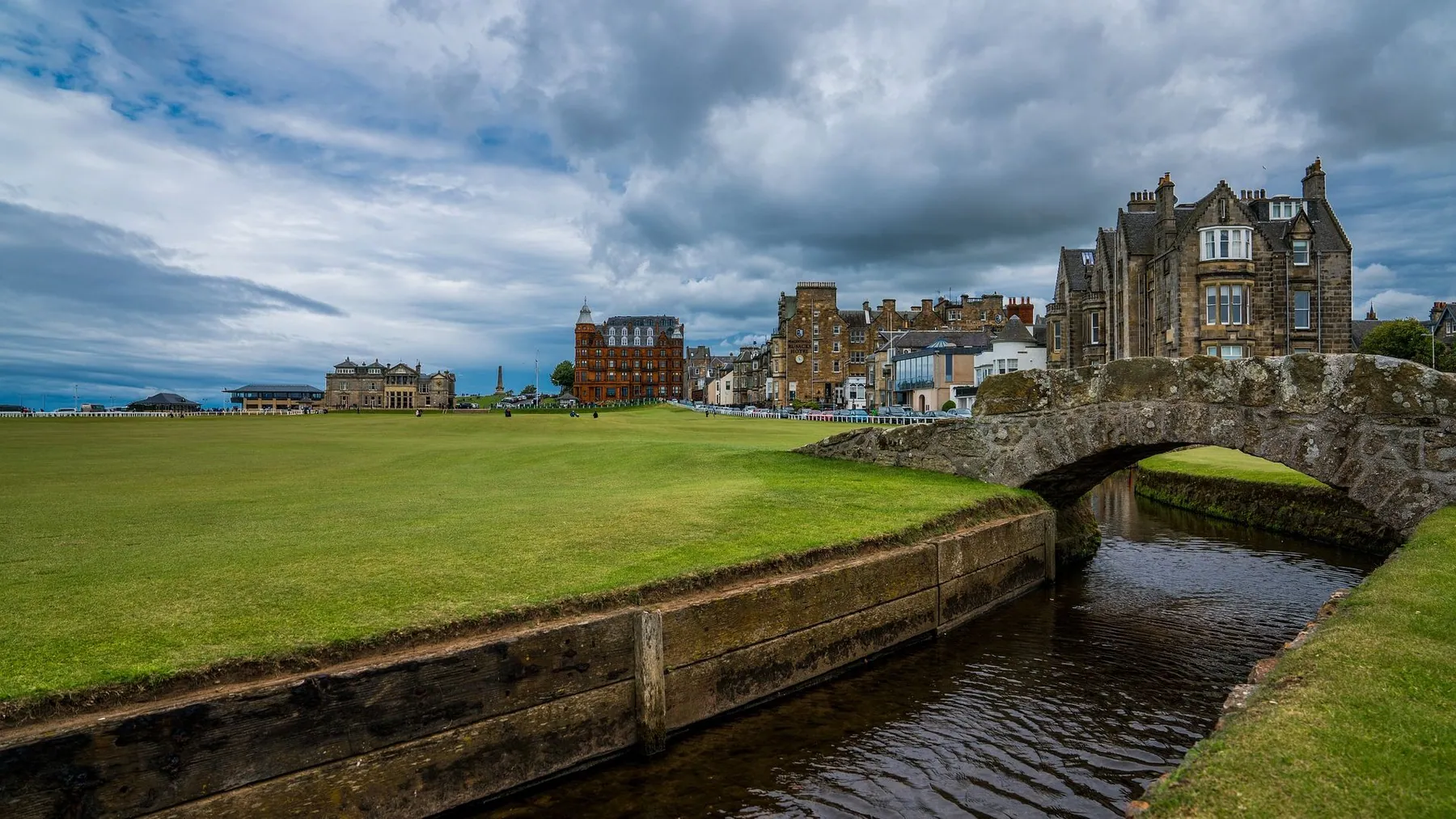
Bernard Darwin begins his chapter on St Andrews with an apology. To know the links properly, he says, you must have played them for years, and he was only an occasional visitor. He could barely tell one famous bunker from another and would not dare argue about the right line at the second. It is charming modesty from the best golf writer of his day, and it sets the tone: these are the notes of a man who loved the place and was a little in awe of it.
What follows is St Andrews as he saw it in 1910. Much has changed since. But the chapter, which you can read in full in the Library, still catches something true about the town.
A whole town given up to golf
Darwin admits that not everybody likes the golf at St Andrews. Nobody, he insists, could fail to like the town. “It may be immoral, but it is delightful to see a whole town given up to golf,” he writes, and he pictures tradesmen grabbing their clubs the moment work is done and hurrying out to the links.
He loved the home green, railed in on two sides, with knowing spectators leaning on the rail and the clubhouse, the clubmaker’s shop and the hotels all around, everyone inside them talking about putts. He tells of meeting a man at a hotel who did not play golf at all, yet joined in the endless golf talk so sensibly that nobody ever found him out.
The bunkers that wait by the greens
He was writing just after the 1910 Championship, which had been played in calm weather on greens softened by rain. Scores were low, and yet, he noticed, the course never looked easy. His explanation is simple: the bunkers sit tight against the greens. Play straight at the flag and a yard’s error, or one unkind bounce, will put you in the sand. The wise golfer gives those bunkers a wide berth and relies on long approach putts, which is why Darwin thought St Andrews rewarded anyone handy with a wooden putter.
Then there is the length, which depends on the wind, and there is the natural ground, whose banks and slopes guard the hole even where there is no bunker. Many sit on plateaux, and a plateau never helps the careless approach. The turf was hard, and the greens could get very fast.
Round the Old Course
Darwin reminds the stranger that St Andrews once had only nine holes, played out and back to the same holes. That is why so many greens are double, with the outgoing and incoming players passing close to each other and plenty of cries of “Fore!”
The first tee shot, in front of the Royal and Ancient clubhouse, is among the least frightening in golf. The trouble is the Swilcan burn in front of the green, a stream he says you could jump across, and which still catches an amazing number of balls.
The second, about four hundred yards, has a pot bunker hard by the hole. The fifth was the long hole out, sharing a huge plateau green with the Hole o’ Cross coming home. Here Darwin passes on a story of young Tommy Morris pitching onto the green with a niblick, when the club was still thought fit only for digging out of trouble. The eighth, at 142 yards, offered a rare chance of a three. The ninth and tenth he thought a small blot on the course: on less hallowed ground they would be dismissed as a drive and a pitch up and down a flat field.
The short hole in
Then came the eleventh, the “short hole in”, which Darwin called “the most fiendish short hole in existence.” Strath bunker sat to the right, the Shelly bunker to the left, and the hole was usually cut close to Strath. He advises playing well away to the left, because trouble here may not stop until the card is torn up. Get out of Strath too strongly and you are over the green in the Eden. Come back from there down the slope and you may trickle into Strath again. He watched exactly this happen to Massy in the 1910 Championship, and Massy took six.
Harry Vardon, writing in The Complete Golfer, had no doubts either. To him “the eleventh is the finest one-shot hole to be found anywhere.”
The way home, and the seventeenth
The thirteenth, the Hole o’ Cross, was a great hole, with Walkinshaw’s Grave to avoid on the way to a big plateau green. The fourteenth, the long hole home, ran along the Elysian fields, past the little pot bunkers called the Beardies, with Hell waiting for a bold second shot. The sixteenth meant threading a drive between the Principal’s Nose and the railway line, which was not out of bounds, so you could hack away at a sleeper for as long as you liked.
The seventeenth Darwin calls the most praised and most abused hole in the world, and he sums it up: “Many like it, most respect it, and all fear it.” There was the drive, with the station-master’s garden out of bounds on the right. There was the long second. And there was the approach to a small, narrow plateau between a greedy bunker and a hard road. In 1910 he watched Braid’s ball lie in that bunker at a crucial moment. Down came the niblick, and the ball finished close to the hole, safely clear of the road. Vardon, for his part, thought the seventeenth unfair.
The eighteenth, after all that, asked only that you cross the burn, keep out of Rusack’s hotel and hole out in front of the people on the railings.
The New Course
Darwin was kind but firm about the New Course, which ran alongside the Old. It was younger, softer and slower, and most of its greens lacked the natural protection that made the Old so testing. He liked the short fifth, played to a plateau, and the tenth, which ran down a narrow gorge. But when Mr Low wrote that it was probably the second course in Scotland, Darwin politely said no. “It has ‘relief course’ plainly written all over it,” he wrote, and on his last visit daisies had been growing on the greens.
Still, he admitted that when the crowds on the Old grew too much, it was a fine place to slip away to for a quicker round. Then, like every pilgrim, he went back to the Old Course.
More from Places
See allThe Courses of Bernard Darwin’s 1910 Guide
The 62 courses Darwin features in The Golf Courses of the British Isles, from Sandwich to Lahinch, grouped by region and linked to the chapter where he describes each one.
A Quiet Corner on the Coast
Every golfer has one course they love beyond reason. Bernard Darwin’s was a small links on the Welsh coast, and he wrote about it like a man coming home.
Where the fairway meets the sea.
Wind, sand and short grass by the shore: what makes seaside golf the oldest and still the most beguiling form of the game.